INTERACTIVE LIVE LEARNING LAB
Micronutrient Solutions for Autism + Severe ARFID
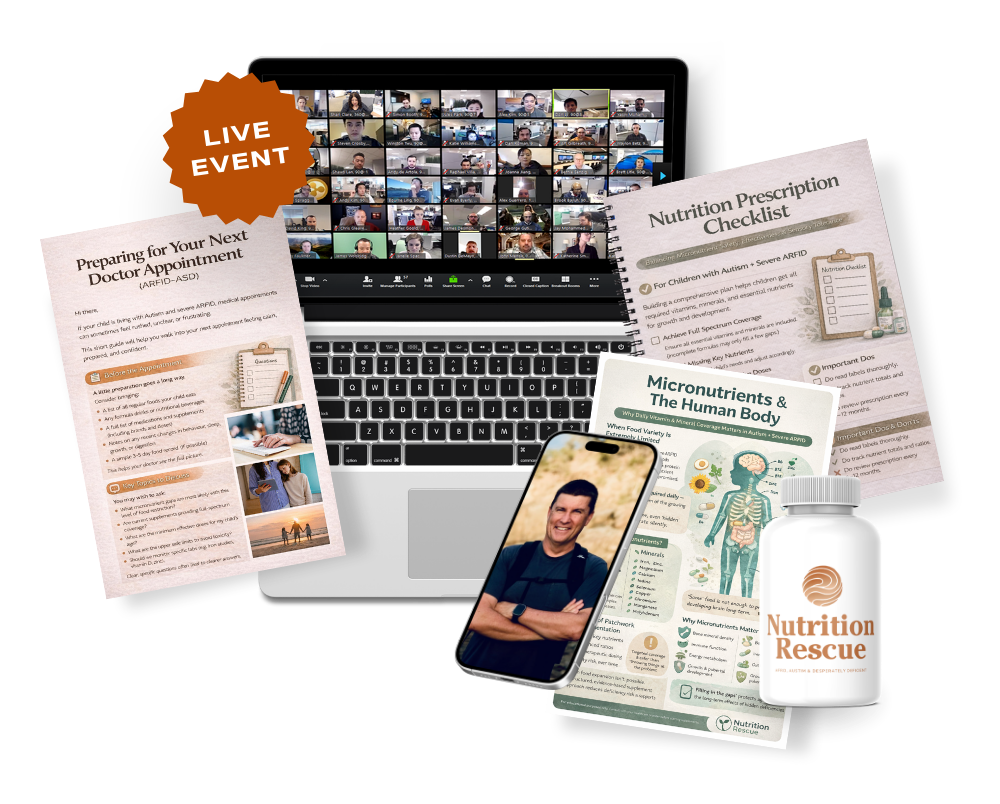
A live, interactive Learning Lab for families navigating Autism and severe ARFID. Learn how to assess and correct micronutrient gaps when your child eats fewer than 10 foods (and probably eats almost nil fresh wholefoods).
When Your Child Can’t Eat Enough Variety, Micronutrients Still Matter...
But You Need a Different Approach

When a child eats fewer than 10–15 foods and almost nil fresh wholefoods, this is not just a feeding issue. It is a nutrition risk that impacts development, brain function and future health outcomes.
Weight gain alone does not guarantee adequacy.
- Normal basic blood tests do not rule out meaningful deficiencies.
- And either doing nothing or using a patchwork of supplements will not resolve micronutrient status in severe ARFID.
Low-variety diets predictably miss essential vitamins, minerals, omega-3 fatty acids and prebiotic fibres. These gaps can affect brain development, emotional regulation, attention, gut function, sleep, bone strength and long-term metabolic health.
Most families are offered partial solutions.
- One or two nutrients at a time.
- A generic multivitamin.
- Or more feeding therapy.
EXCLUSIVES IN THIS LEARNING LAB:
Evidence-Based Micronutrient Strategy
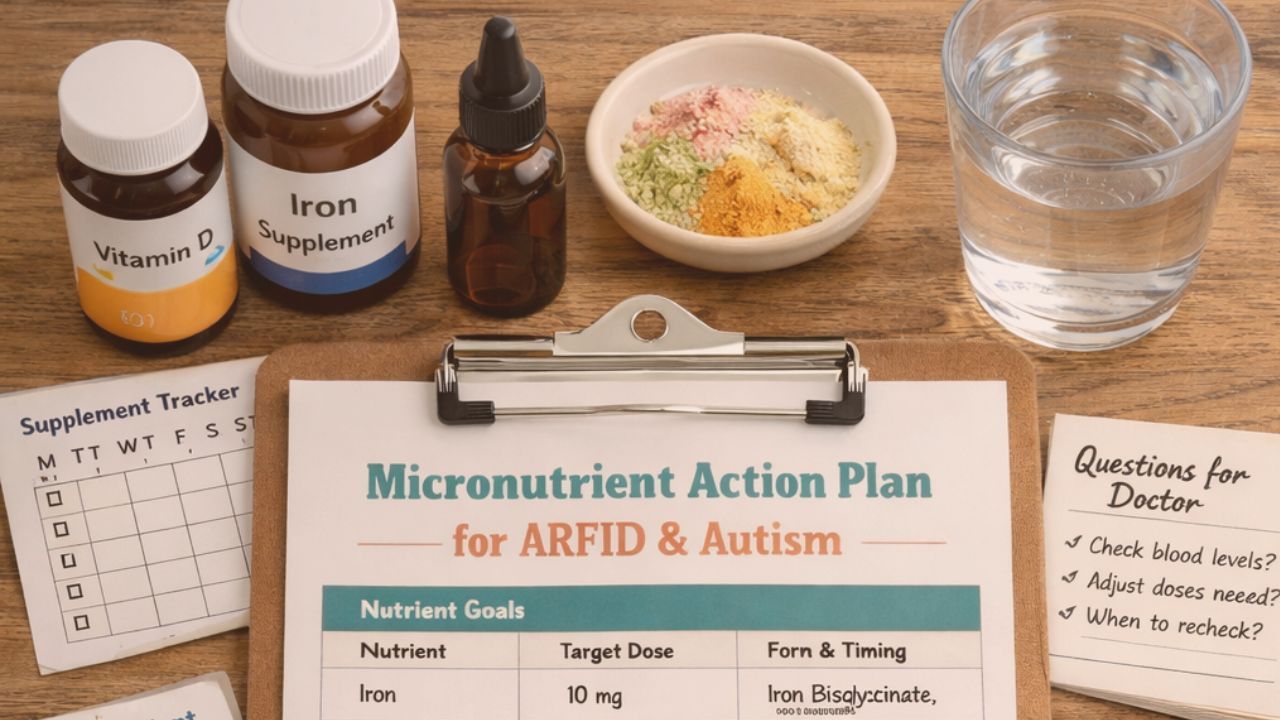
You will learn how to identify predictable micronutrient gaps in children eating fewer than 10–15 foods (and almost nil fresh wholefoods), and how to build structured, comprehensive coverage without creating toxicity risks. This session focuses on minimum effective paediatric doses, safe upper limits, limitations of routine blood testing, and how to avoid incomplete or patchwork supplementation. The goal is clarity, safety and full-spectrum micronutrient protection.

Methods for Rigid, Sensory-Sensitive Eaters
Severe ARFID requires more than handing over a supplement. You will learn practical strategies for selecting realistic product formats, introducing supplements gradually, and using precision-mixing methods to reduce resistance in highly rigid or demand-avoidant children. Success depends on method as much as product, and this workshop shows you how to approach both calmly and systematically.

Live Interactive Problem-Solving Workshop
This Learning Lab is structured as a facilitated, interactive, step-by-step problem-solving workshop led by Michael Hann, Consultant Pediatric Dietitian, rather than a lecture. You will apply what you learn in real time, work through guided exercises, and think through practical next steps relevant to your child’s situation. Michael will share clinical insights from years of working with severe ASD-ARFID cases, helping you refine your thinking and leave with a clearer, structured plan to move forward with confidence.
And underneath all of this sits a question most doctors cannot clearly answer:
Are micronutrient deficiencies making this worse?
When diets are dominated by a small number of ultra-processed foods (UPFs), children are not just missing vegetables, legumes, fruits, seeds, nuts and wholegrain foods. They are missing essential vitamins, macro minerals, trace elements, omega-3 fatty acids, prebiotic fibres and hundreds of other phytonutrients that support gut and brain development.
These gaps can operate quietly for years.
❌ Not dramatic.
❌ Not obvious.
❌ Well hidden.
But physiologically significant.
This Learning Lab exists because ignoring micronutrient risk does not protect your child. Structured action does.

Not sure if this Learning Lab is right for your family?
Take this short quiz to see if this is a good fit for you right now.
It takes less than two minutes and helps you decide whether this Learning Lab matches your child’s needs and your current situation.
This is a structured, clinician-led Learning Lab, focused on reducing micronutrient risk and helping families identify safe, realistic next steps.


Limited places available to maintain interaction quality and clinical relevance.
About your Learning Lab Facilitator
When food variety cannot expand in children or teens with Autism and severe ARFID, most families are left without clear, structured guidance. This Learning Lab was created to address that gap.
Michael Hann is a Consultant Paediatric Dietitian who works exclusively with children presenting with severe ARFID and complex Autism.
His clinical focus is on high-restrictive cases where standard nutrition advice, generic multivitamins, and feeding therapy alone are not enough.
In this session, Michael draws on years of real-world clinical experience to guide parents through evidence-based micronutrient strategy, supplementation safety, and practical implementation for highly rigid, sensory-sensitive children. The focus is structured risk reduction, not guesswork.
This Learning Lab does not replace medical care and it is not about diagnosing or treating conditions. It is designed to help parents think clearly, ask better questions, and navigate nutrition decisions alongside their child’s medical team with greater confidence.
Enroll in the Learning LabLET OUR PARENTS’ EXPERIENCES SPEAK FOR THEMSELVES…

From constant guesswork to a clear nutrition plan that finally made sense.
We had tried feeding therapy, supplements, and endless advice, but nothing tied it together. The Nutrition Rescue approach helped us understand what actually mattered nutritionally, without pushing food exposure that wasn’t realistic for our child. For the first time, we felt calm and confident about what we were doing day to day.
Parent of a child with Autism & ARFID
[Australia]

From patchwork supplementation to a more structured approach.
What stood out was the focus on safety and completeness, not quick fixes. Nutrition Rescue helped us move away from random supplements and toward a more thought-through plan that fit our child’s rigidity and sensory limits. It finally felt aligned with our reality.
Parent of a neurodivergent teen
[USA]

From feeling dismissed to feeling informed and prepared.
We’d been told repeatedly that our child would ‘grow out of it’. Nutrition Rescue gave us language, understanding, and a framework that helped us feel more prepared for conversations with health professionals. It didn’t replace medical care, but it helped us engage with it more confidently.
Parent of a child with complex Autism
[Australia]